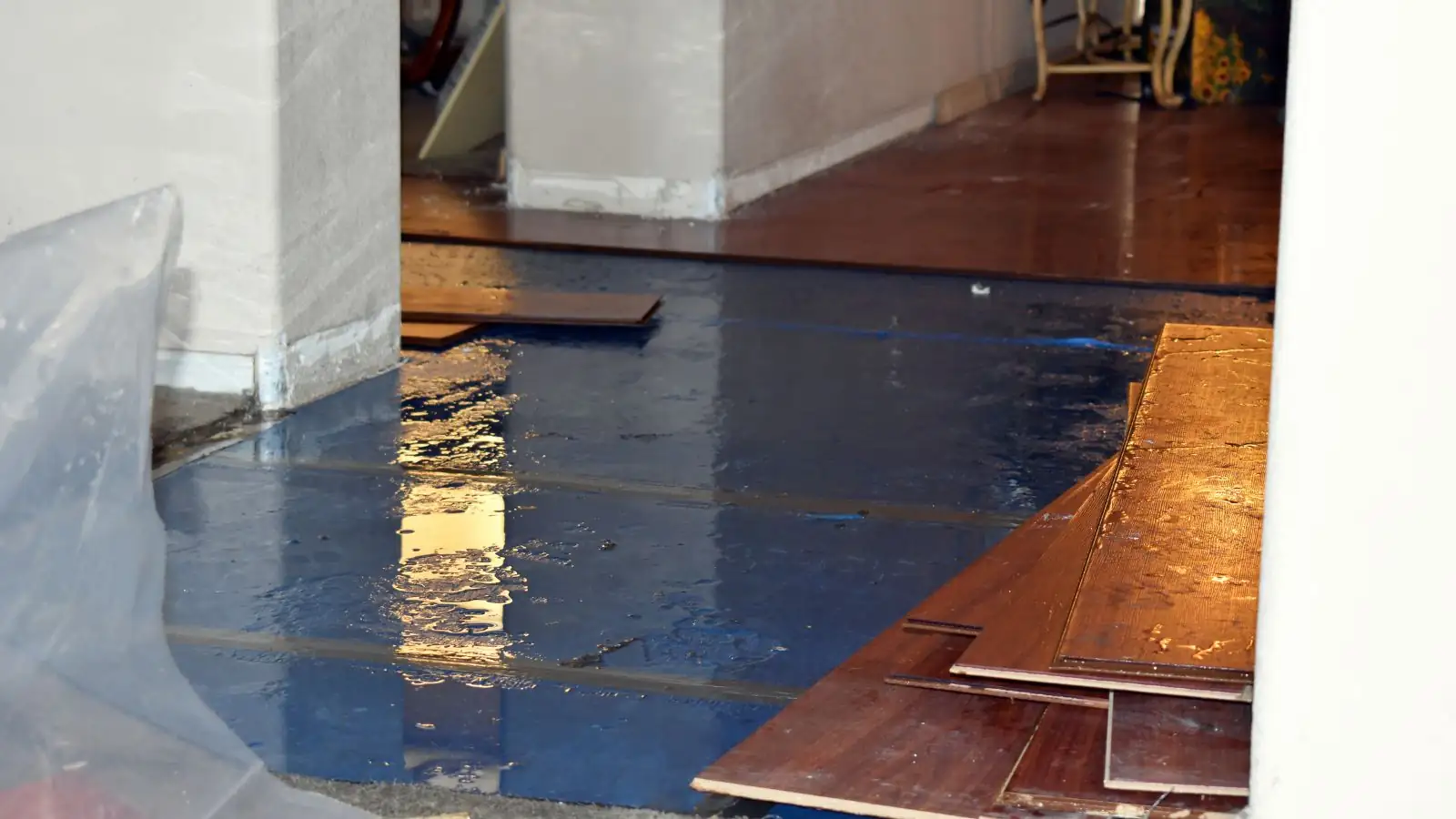
A water damaged wood floor can sometimes be saved, and sometimes it cannot. The difference comes down to how much water got in, how long it stayed, and what is underneath the boards. Wood swells when it absorbs water, and the boards push against each other and against the subfloor.
This guide explains the warning shapes you will see, what moisture readings mean, what drying mats do, and how to choose between sanding and refinishing or tearing out and replacing.
Cupping, crowning, and buckling explained
Cupping is when the edges of each board rise higher than the center, so the floor looks like a row of shallow troughs. It happens when the bottom of the board is wetter than the top. Crowning is the opposite, with the center higher than the edges, and it often shows up after a cupped floor has been sanded while still damp.
Buckling is the serious one. The boards lift off the subfloor, sometimes in a ridge or a tent, because they swelled so much that they ran out of room. A buckled floor usually means a lot of water for a longer time, and replacement becomes more likely.
Common leak scenarios and how they behave
A washing machine supply valve that fails behind the machine can pour water for a long time before anyone notices. The water spreads into the hallway or the next room, and the boards at the leak edge cup first. A dishwasher leak is slower and tends to wet the floor under the cabinet kick plate, where nobody is looking.
Refrigerator ice-maker lines, water heater leaks, and sink supply lines follow the same pattern. If the source is slow, the water travels under the finish and into the seams. By the time you see a rise in the boards, the subfloor may already be wet.
Describe the damage to a live dispatcher and get a clear next step.
☎ Call (562) 271-5850Read the moisture before you decide
Never judge a wood floor by how it looks or feels. A pin or pinless moisture meter reads the actual moisture content of the boards and the subfloor. A pro compares those numbers against a dry area of the same floor, often one in another room, to find the real target.
A thermal imaging camera helps show where the wet area runs, including under cabinets and baseboards. Readings are repeated every visit, so you can see whether the floor is drying or still holding water. Flooring that looks flat but reads wet is not ready to be sanded.
What drying mats and air movers do
Wood is hard to dry because the water sits in the boards and the gap below them. Drying mats pull moisture out of the boards using suction through the surface, while air movers and LGR dehumidifiers dry the air around them. Our water mitigation crews set this up soon after the water is extracted.
For some floors, a few boards are removed along the edge to open the cavity and speed the drying. The goal is to bring the wood back to the reference reading slowly, because drying it too fast can split or warp the boards. Many cupped floors flatten once they are dry, and some do not.
Dry, refinish, or replace: a decision guide
Once the floor is dry, you have three outcomes. The table lays them out by what you see and what the readings say.
| What you find | Likely outcome | Why |
|---|---|---|
| Light cupping, readings back to normal, finish intact | Dry and leave it, or screen and recoat | Boards often settle flat as moisture leaves |
| Cupping that stays after drying, boards still solid | Sand and refinish | Sanding levels the edges once the wood is stable |
| Gaps between boards, no lifting | Wait, then refinish | Boards shrink back as they dry, and gaps often close partly |
| Buckling or boards lifted from the subfloor | Replace the affected area | Swollen boards seldom return to their original shape |
| Wet subfloor or damp insulation below | Open, dry, and replace as needed | The structure must be dry before new boards go down |
| Black staining or a musty smell | Stop and have it checked | Moisture has sat long enough for growth, and the cause must be handled first |
Waiting is part of the process. Rushing to sand a floor that still reads wet is the surest way to ruin it.
Sanding, refinishing, and what to expect
Sanding removes the top layer of wood and the finish, so it only works if the floor has enough thickness left. Engineered floors have a thin top layer of real wood and can only be sanded once or twice. Solid hardwood can take more passes.
A refinished floor is stained to match if needed and sealed with a clear coat. Stain color rarely matches the old floor perfectly, so many people refinish the whole room instead of a single patch. Our water damage repair crews handle the tear-out, the board work, and the refinishing as one scope.
What to do in the first hours at home
- Shut off the water and fix or isolate the source.
- Mop or vacuum standing water and lift area rugs and mats.
- Move furniture, and put foil or plastic under any legs that must stay.
- Run fans and the air conditioning to move air over the floor.
- Do not use a heat gun, steam, or floor heat to speed the drying.
- Take photos and note when the leak started.
Skip the tempting shortcuts. Heat can crack boards, and sealing a damp floor with wax or polish traps moisture.
When to stop and call
Call if water has reached the subfloor, if boards have lifted, or if the floor still reads wet after a few days of fans. Call if the water came from a dishwasher or washing machine line, because those are Category 2 water. Also call if you see dark spots or smell a musty odor.
We serve Pico Rivera and nearby towns, including Downey and Santa Fe Springs. Scope and price are explained before work starts, and the real number comes after someone has measured the floor and the subfloor.
Insurance for wood floor claims
Sudden and accidental leaks, such as a failed washer valve, are often covered. A slow dishwasher drip that went on for months often is not. Ask your insurer what applies and keep a claim diary.
Photos of the boards before and after drying help. Wait for the adjuster before replacing flooring permanently.
Ask the company whether its crews work to ANSI/IICRC S500, the published water damage restoration standard, and how moisture in the boards and subfloor will be measured before anyone decides to sand or replace.
Pico Rivera note: when a wet floor comes from outside, not from a pipe
The city sits between the Rio Hondo and the San Gabriel River, and storm drains carry runoff toward those channels. After heavy rain, a wood floor that gets wet near an exterior door or garage-level room may be an outside-water problem. Check gutters, downspouts, and the grade along the wall, and look up your address on the FEMA Flood Map Service Center so you know whether your policy question is about flood.
Frequently asked questions
Often yes, if the source is fixed and the floor dries slowly and fully. Cupping that remains after the wood has dried to normal readings can be sanded flat. Do not sand early, since a floor that is still damp can crown after sanding.
It depends on the water amount, the wood type, and whether the subfloor is wet. Wood dries slowly, so expect days rather than hours, with readings taken each visit. The meter, not the calendar, says when it is done.
Sometimes. Engineered boards have layers that can separate when wet, so the top layer may delaminate. Light, brief wetting may dry out, but swollen edges and lifted layers usually mean replacement.
Leaving it wet lets the boards swell more and gives hidden moisture time to cause other problems. Get the water out and start drying quickly. If you notice a musty smell, ask for a moisture check.
Replacing flooring is usually non-structural, but permit rules vary. If the repair involves plumbing, electrical work, or interior demolition, ask the city Building Division. A licensed contractor can tell you whether your scope needs a permit.
Water on the floor right now? The dispatch line is open 24/7.
☎ Call (562) 271-5850