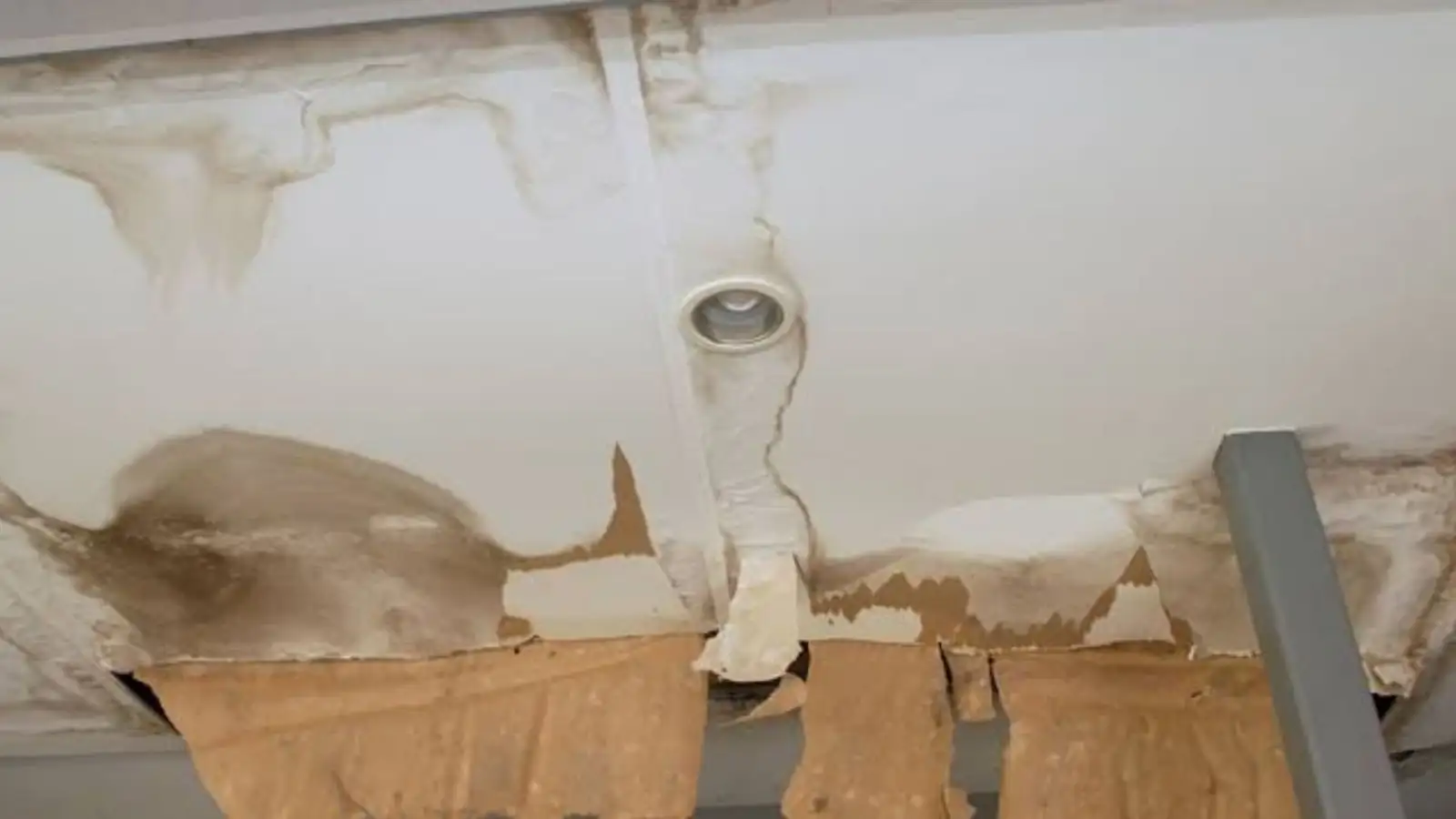
This guide starts after the hard part. The leak has been found and stopped, and a moisture meter says the ceiling and the space above it are dry. Now you have a stained or sagging ceiling and a choice about how to repair it.
A proper water damage ceiling fix follows a fixed order. Cut out what is ruined, check what is behind it, patch, texture, prime, and paint. Skip a step and the stain, the sag, or the texture mismatch shows up again.
Confirm the ceiling is truly dry before you repair anything
Patching over damp drywall is the most common reason repairs fail. Wet gypsum swells, grows mold if it stays damp, and pushes tape and mud off the surface. A ceiling can feel dry and still read wet inside.
A pro checks with a pin or pinless moisture meter and sweeps the area with a thermal imaging camera to find cool, damp pockets. If the leak was large, drying with air movers and LGR dehumidifiers comes first, and our water mitigation work covers that stage. Compare readings in the damaged area against a dry part of the same ceiling, not against a number you found online.
The repair sequence from cut-out to paint
Here is the order a careful repair follows, with a note on how much a handy homeowner can take on. Small stains on firm drywall are within reach for many people. Sagging, large, or wiring-adjacent areas are not.
| Step | What happens | Who usually does it |
|---|---|---|
| 1. Cut out | Remove soft or stained drywall back to firm, dry edges, cutting to the middle of a joist when possible | Homeowner for a small patch, pro for large areas |
| 2. Inspect and dry | Check insulation, framing, and wiring for dampness. Replace wet insulation | Pro, with meters and a camera |
| 3. Hang new board | Fasten a new piece of drywall to the joists, flush with the old surface | Homeowner or pro |
| 4. Tape and mud | Embed paper or mesh tape, then apply thin coats of joint compound, sanding between coats | Homeowner with patience, pro for a clean finish |
| 5. Texture | Match the existing ceiling texture, such as knockdown or orange peel | Pro for large or visible ceilings |
| 6. Prime and paint | Seal with stain-blocking primer, then paint the whole ceiling plane edge to edge | Homeowner or pro |
Notice how little of this is painting. Most of the work and most of the skill sit in the cutting, the drying checks, and the texture match.
Describe the damage to a live dispatcher and get a clear next step.
☎ Call (562) 271-5850Cutting out the damaged drywall and what to look for behind it
Cut a clean rectangle around the damage, extending to firm board. Wear a dust mask and eye protection, because ceiling debris falls straight down. Keep the cut away from lights, fans, and visible wires, and shut off that circuit at the breaker first.
Once the board is open, look at the insulation. Insulation that is wet, matted, or stained should come out, because it holds water against the new board. Check the framing for dark patches and the underside of the roof sheathing or floor above for signs of the original leak.
Patching, taping, and matching the texture
Screw new drywall to the joists with the screw heads just below the surface. Tape the seams and apply joint compound in thin coats, letting each coat dry fully. Sand lightly between coats and wipe the dust before the next one.
Texture is where most do-it-yourself ceilings give themselves away. A smooth patch in a knockdown ceiling shows from across the room, especially in side light from a window. Spray texture and hand-applied texture look different, so a pro will test a small area first to match the pattern.
Prime, then paint the full ceiling
Seal the patch with a stain-blocking primer, and spot-prime any old stain rings nearby. Then paint the entire ceiling from wall to wall in one session. Painting only the patch leaves a visible halo, because old ceiling paint fades and new paint does not match.
Use a flat ceiling paint, roll in one direction, and keep a wet edge. If a stain bleeds through the first coat, add a second coat of primer before the finish coat. A bleed-through almost always means the source or the board was not fully dry.
What a professional handles that you probably should not
Hire help when the damaged area is larger than a few square feet, when the ceiling is textured and visible, or when wiring, recessed lights, or ductwork sit in the cut zone. Pros also handle ceilings that sagged because the framing or insulation is involved. Our water damage repair crews cut, rebuild, texture, and paint as one scope, so the repair does not depend on several trades lining up.
Another reason to call is moisture that will not go away. If readings stay high after the source is fixed, something above is still wet. Stop work, because closing the ceiling over a wet cavity locks the problem in.
When to stop and call
- The ceiling is still soft, stained, or darker after the leak is fixed.
- Insulation above the cut is wet or smells musty.
- You find old wiring, scorch marks, or wet electrical boxes.
- The damaged area is larger than one sheet of drywall.
- The ceiling stain returns after painting.
- The leak came from a drain or sewer line, which is a contamination issue, not a cosmetic one.
Any one of these means the repair has moved past a weekend project. A short inspection with meters costs far less than rebuilding a ceiling twice.
What shapes the cost of a ceiling repair
Cost depends on the size of the damaged area, the texture type, whether insulation or wiring work is needed, and how much drying was done first. A ceiling that was wet from clean supply water is simpler than one hit by a drain line. Height and access matter too, since a vaulted ceiling takes more setup.
The real number comes after someone sees the loss. Scope and price are explained before work starts, and we serve homeowners across Pico Rivera and in nearby Montebello and Santa Fe Springs.
Ask any contractor whether drying was checked against moisture readings before the ceiling was closed, which is the approach described in the ANSI/IICRC S500 water damage restoration standard.
Pico Rivera note: permits for ceiling repairs that touch wiring or pipes
The city Building Division handles building permits. Electrical or plumbing work almost always needs a permit, and interior demolition may too. Non-structural cosmetic changes, such as patching and painting a ceiling, usually do not. If your repair involves a light fixture, a wire, or a pipe above the ceiling, call the Building Division before the cut and ask what applies, because permit rules vary.
Frequently asked questions
Wait until the source is fixed and a moisture meter confirms the drywall and framing are dry. Time alone is not the test. A ceiling that looks dry can still hold moisture, so measure it before you close it up.
Usually only the damaged section. Cut back to firm, dry board and replace that piece. The whole ceiling gets primer and paint afterward so the repair blends. If most of the ceiling is soft or sagging, replacing more board makes sense.
If it is wet, matted, or smells musty, it should come out and be replaced. Wet insulation holds moisture against new drywall and can undo the repair. Dry insulation with only a stain is often fine.
Usually because the board was not fully dry or the leak is still active. Stain-blocking primer helps, but it cannot stop moisture. Recheck the source, measure the ceiling again, and add a second coat of primer if needed.
Patching and painting usually do not, but electrical or plumbing work almost always does. If you are unsure, ask the city Building Division before you start. A licensed contractor can tell you what applies to your scope.
Water on the floor right now? The dispatch line is open 24/7.
☎ Call (562) 271-5850