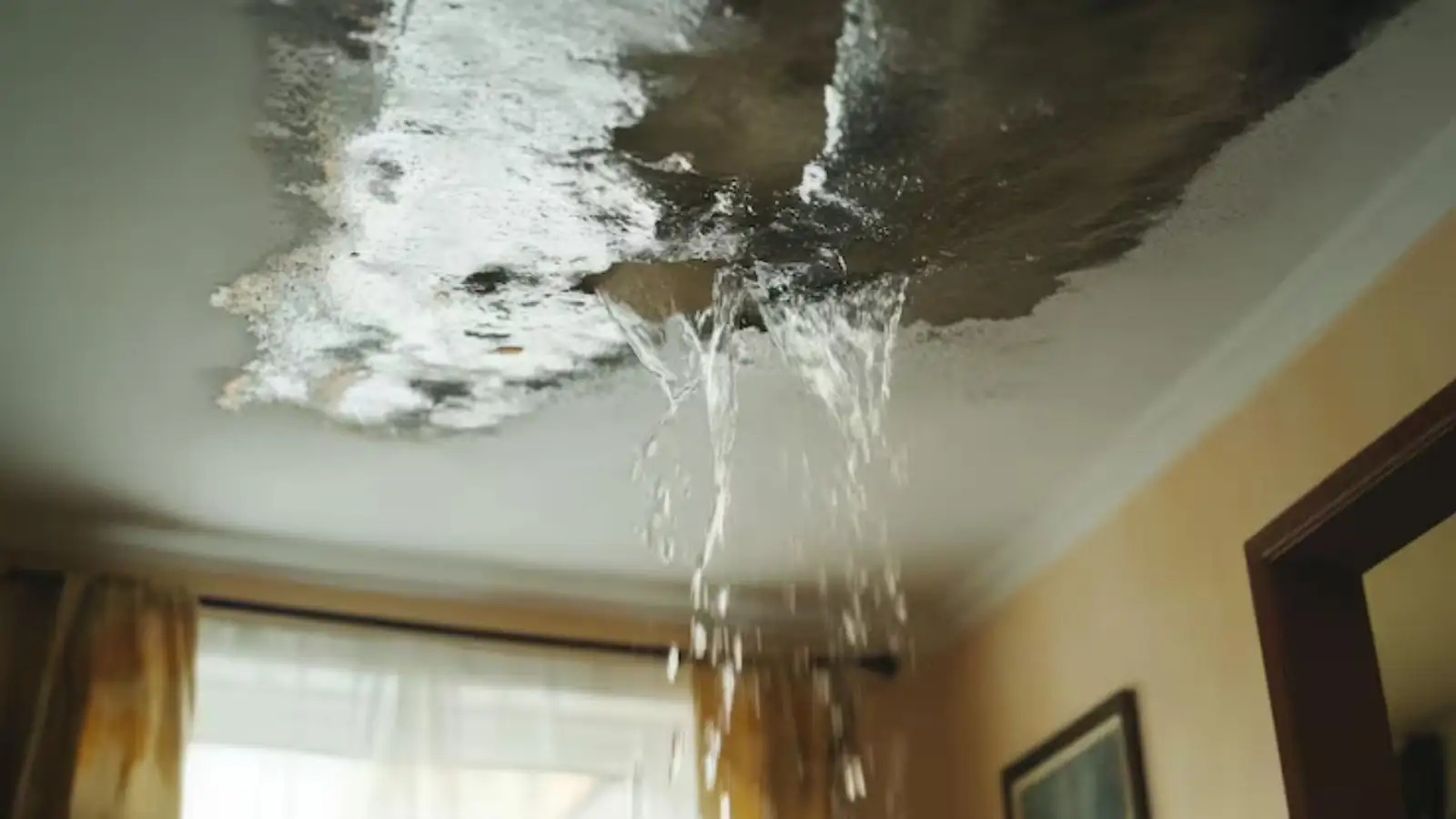
It is nine at night, the ceiling is dripping, and you need to decide what to do with your own hands. Some actions are safe and helpful. Others can hurt you or make the damage bigger.
This guide draws a clear line. It covers what you can do tonight, what to leave alone, and how to decide when to fix ceiling water damage yourself and when to hand it off.
What is safe to do yourself tonight
The safe actions are the simple ones. They reduce damage without putting you under a wet ceiling or near wiring. Do them in this order and stop when the water is under control.
- Set a bucket or tub under the drip, and lay towels around it.
- Move furniture, electronics, and rugs away from the wet area.
- Photograph the ceiling, the floor, and any damaged belongings.
- Turn off the main water valve if you think a pipe is the source.
- Open windows or run a fan in the room to move air, if no water is near the outlet.
- Write down the time the leak started and what was running.
None of these needs a ladder or a tool. They also build the record you may need for an insurance claim.
The small hole trick and when it helps
If the ceiling has a bulge that is clearly full of water, a small drain hole can prevent a bigger collapse. Stand to the side, not under the bulge. Poke a screwdriver through the lowest point of the bulge and let the water run into a bucket.
Do this only if the bulge is away from lights, fans, and any wiring, and only if you can stay out of the falling debris zone. Put a tarp or plastic sheet on the floor first. If the bulge sits near a fixture, leave it and call for help.
Describe the damage to a live dispatcher and get a clear next step.
☎ Call (562) 271-5850What to leave alone
Do not stand under a sagging ceiling, and do not climb a ladder to cut it open while water is still coming through. Do not touch a wet light fixture, switch, or outlet. Do not use a vacuum on standing water, and do not walk around the room if the ceiling is bulging.
Never go up on a wet roof to look for the leak in the dark, especially in the rain. The call that sounds like a roof job may actually be a plumbing or AC drain job, and that is something a trained eye sorts out in daylight.
Decision framework: DIY, cautious DIY, or call a pro
Use the table below to size the job honestly. A small, dry, cosmetic stain is a DIY candidate. A wet, sagging, or electrical-adjacent ceiling is not.
| Situation | Verdict | Why |
|---|---|---|
| Small stain, dry, no softness, source fixed | DIY | Needs only stain-blocking primer and paint once confirmed dry |
| Drip stopped, ceiling damp, small area | Cautious DIY | Dry the room, then have the drywall checked with a meter before closing it up |
| Soft spot or sag the size of a dinner plate or larger | Pro | Wet drywall can fall, and insulation above is probably wet |
| Water dripping from a light, fan, or vent | Pro, after the utility if there is risk | Electrical safety comes first |
| Ceiling bulging with water | Pro | Relieve it only if safe, then call for extraction |
| Leak from a toilet, drain, or sewer line | Pro | Contaminated water needs protective gear and proper cleanup |
| Stain keeps coming back | Pro | The source is not fixed or the cavity is still wet |
If you land in the middle of the table, treat it as the more serious row. The cost of waiting is usually higher than the cost of a short inspection.
Tool and safety limits for a homeowner
A homeowner can safely use a drywall knife, a hand saw, a dust mask, safety glasses, and a stepladder on a dry ceiling. That is enough for a small patch. It is not enough for a ceiling that may be wet through, because wet board is heavy and breaks unpredictably.
Rental fans and dehumidifiers dry a room, but they cannot tell you whether the wall cavity or attic floor is dry. A pro uses a moisture meter, a thermal imaging camera, air movers, and LGR dehumidifiers together and records readings day by day. If you are renting equipment to save money, make sure someone is measuring the result.
When to stop and call
Call for emergency help if the ceiling is bulging, water is moving through a fixture, or you cannot tell where the water is coming from. Our emergency water removal line runs 24/7 with same-day response when available, and we never promise an arrival time we cannot keep.
If the electrical panel is wet or you smell burning, leave the area and call the utility or 911 first. After the emergency, the cut-out, patch, texture, and paint come under water damage repair, which is a separate and calmer step.
What the first professional visit looks like
An inspection starts with a walk-through and questions about when the leak began. The crew checks the ceiling, the walls below, and the room above with moisture meters and a thermal imaging camera. They mark the wet area so you can see its real size.
Then they explain the scope, the equipment needed, and the likely price before work starts. If drying is needed, air movers and dehumidifiers are set and readings are logged on each visit. Nothing is cut or removed until you understand why.
Matching the job to your insurance
Sudden and accidental ceiling leaks are often covered, while slow leaks and neglect often are not. Flood is usually excluded and needs separate flood coverage. Check your policy and ask your insurer.
Make temporary repairs that stop more damage, but hold off on permanent ones until the adjuster has seen the ceiling. Keep receipts and a claim diary. We serve homeowners in nearby Downey and Montebello as well as Pico Rivera, and the paperwork habits are the same everywhere.
If a professional does take over, ask whether the crew works to ANSI/IICRC S500, the published water damage restoration standard, so drying is measured rather than guessed.
Pico Rivera note: ask for the license before anyone touches plumbing
The city says express residential plumbing permits require an active California contractor license and a City business license. If your ceiling leak traces to a pipe that needs cutting or replacing, ask any plumber or contractor for both before you sign anything. A company that cannot show them may not be able to pull the permit for the work.
Frequently asked questions
Usually not while it is still wet. Wet drywall is heavy, weak, and can fall in pieces, and the wiring above may be damp. Wait until the source is stopped and the board is dry, or call a pro to open it with the right protection.
Turn off the circuit for that room only if the panel is dry and you can reach it safely. If water is coming through a light fixture or you smell burning, leave the area and call the utility or 911 first.
A fan helps move air, but a space heater is a fire risk near wet materials and furniture. Drying a ceiling properly means measuring moisture in the board and the cavity above, not just feeling the surface.
Take wide shots of each room, close shots of the stain and any sag, and photos of damaged belongings. Add the date and note what was running when the leak started. Save everything before you move or throw anything away.
Cosmetic patching and painting usually need none. Electrical or plumbing work almost always does, and demolition may too. Ask the city Building Division about your scope, since permit rules vary by project.
Water on the floor right now? The dispatch line is open 24/7.
☎ Call (562) 271-5850